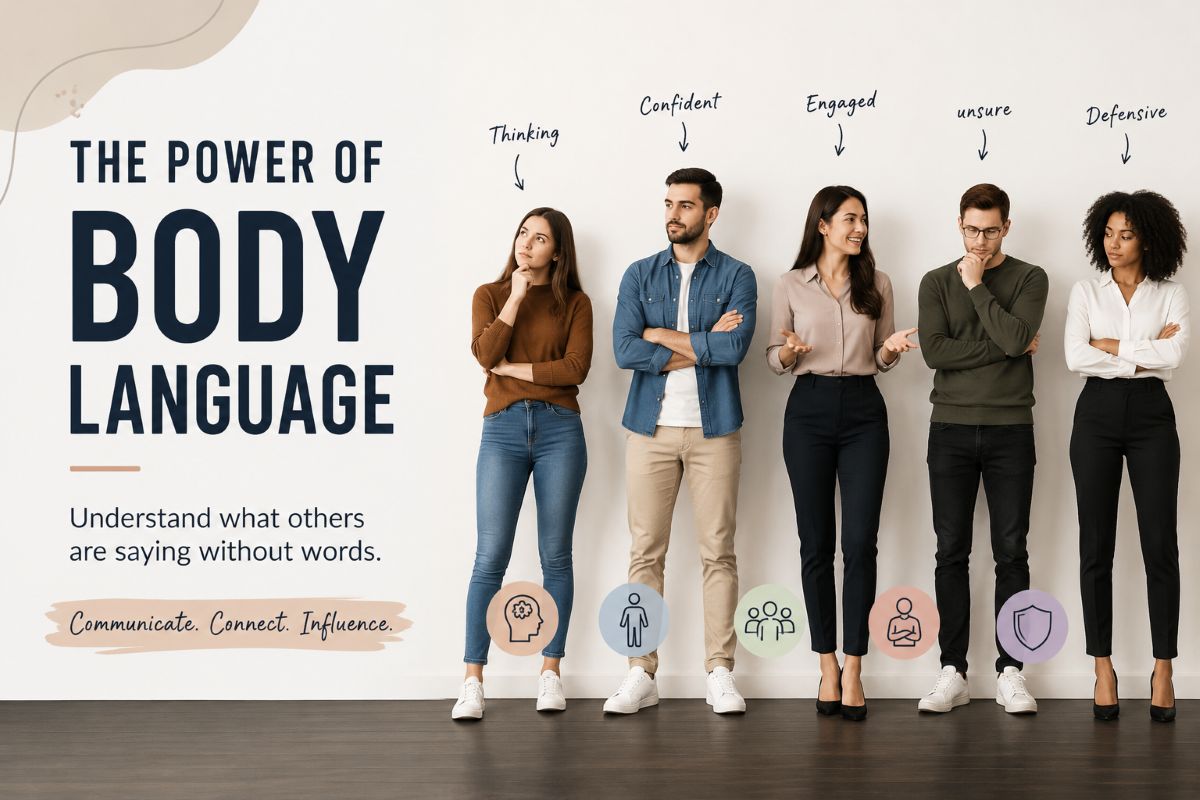
Why Body Language Is Important for a Software Developer
When we think of software developers, we often imagine them focused only on the (messy) code. But in an usual collaborative work environment, technical skills alone are not enough. Body language does significantly influence how you are perceived, how you connect with your team, and how effectively you convey your ideas. We will try here in a few points to summarize why body language is important for developers and what we should pay attention to:
1. Improves Team Communication
Developers regularly work in teams; they participate in daily stand-ups, code reviews, brainstorming sessions, internal workshops… Positive body language like an eye contact, open posture, and nodding shows attentiveness and fosters trust, helping ideas flow more easily.
2. Boosts Leadership Presence
As developers grow into senior roles or team leads, their ability to inspire and influence others becomes crucial. Confident body language supports verbal communication and reinforces authority and clarity.
3. Enhances Presentation Skills
Whether you’re demoing a project or explaining a complex architecture to non-technical stakeholders, your gestures, facial expressions, and posture can make the difference between confusion and clarity.
4. Reduces Miscommunication
In diverse teams, especially in cross-cultural ones, body language can be beneficial where words may fail. Being aware of your own non-verbal signals and interpreting others’, can prevent potential misunderstandings.
5. Improves Interviews and Career Growth
Whether you’re applying for a job or seeking internal promotion, your body language during interviews or meetings plays a crucial role in how competent, confident, and trustworthy you may seem.
Books To Consider
Above, we mentioned few points why body language is important. Bellow are some good books to read on this topic:
-
“What Every BODY is Saying” by Joe Navarro A former FBI agent shares how to decode others’ body language and how to project confidence. https://amzn.eu/d/fSxYUwK
-
“The Definitive Book of Body Language” by Barbara Pease & Allan Pease A comprehensive guide to understanding non-verbal cues in various settings. https://amzn.eu/d/7ENzQQU
-
“Body Language: How to Read Others’ Thoughts by Their Gestures” by Allan Pease A classic that breaks down practical body language for daily interactions. https://amzn.eu/d/2VLgUJT
-
“Presence” by Amy Cuddy Focuses on how body posture affects confidence and presence, including for presentations and meetings. https://amzn.eu/d/3LlQj4c
-
“Louder Than Words” by Joe Navarro Offers deeper insight into how professionals can use non-verbal intelligence to communicate more effectively. https://amzn.eu/d/gpdSaro
-
“The Like Switch” by Jack Schafer A former FBI agent explains how to use body language and psychology to build rapport quickly. https://amzn.eu/d/hbnyqEh
Have you already read some of them? Share your thoughts in the comments!
-
Understanding the Lifecycle of a .NET Core Web API Request
When you send a request to a .NET Core Web API, it goes thru series of steps before a response is returned. Understanding this lifecycle is important in order to built what we need and how to use some of the prebuild functionalities. In this post, we’ll break down the main steps of the .NET Core Web API request lifecycle. →
Premature Optimization
In software development, performance matters, but chasing it too early can lead you into dangerous territory. This is the pitfall of premature optimization, a term that has become a cautionary mantra among developers. As said by Donald Knuth, the phrase “premature optimization is the root of all evil” is not just a quip, it’s a hard-earned lesson from decades of building complex systems. →
Design Patterns: Adapter
The Adapter Pattern is a structural design pattern that allows objects with incompatible interfaces to work together. Rather than modifying existing code to fit a new system, the Adapter Pattern lets us wrap it with a new interface, acting as a bridge between mismatched parts of your application. →
Web API Versioning and Testing
In the previous post, we have paid attention on our project structure and organizing the code in multiple layers to achieve better readability and easier maintanence in the future. Now we can focus on long-term sustainability through versioning and testing. →
Web API Architecture: Services and Repositories
In the previous post, we added global error handling and logging using NLog. Now that we’ve made our API more resilient, it’s time to go forwards with cleaning up the architecture and separate concerns. →
Web API Exception Handling and Logging
In the previous post, we set up a basic .NET 9 Web API project. Now it’s time to take things further by adding global error handling and logging to make our API more robust. →
Web API Project Setup and Migrations
Welcome to the first post in the “.NET Core Web API – Step-by-Step Best Practices” series. In this series, we’ll walk through building a modern, clean, and maintainable Web API using .NET 9. Each post will focus on a specific aspect—from project setup and architecture to testing, migrations, and deployment. →
Understanding State Machines with a Practical Example in C#
State machines might sound like a complex topic, but at their core, they’re just a way to manage different states in a system and control how things transition from one state to another. →
Design Patterns: Prototype
In software development, there are scenarios where creating multiple objects with similar attributes and configurations is necessary. Instead of constructing each object from scratch, a more efficient approach is to duplicate an existing instance. This is precisely what the Prototype Design Pattern facilitates. →